
Curriculum Management and Course Development
Annual Curriculum Review process Overview
The Annual Curriculum Review (ACR) is a structured process that the graduate Program Curriculum Committees (PCC) & Program administrative teams undergo once a year. This is the first step in the curriculum management process. The Annual Curriculum Review (ACR) ensures that programs are academically rigorous, market-relevant, aligned with institutional priorities, compliant with accreditation standards, grounded in systematic assessment of student learning outcomes, and positioned for continuous improvement and distinction.
Key Objectives of the ACR:
- Evaluate curriculum effectiveness and alignment with industry trends.
- Identify opportunities for improvement and innovation.
- Develop a Curriculum Improvement Plan (CIP), which includes proposals for new and redeveloped courses, for the upcoming academic year.
The ACR takes place prior to fiscal year planning & the annual budget cycle – from Spring into Summer each year for the upcoming academic year (fall, spring, and summer terms). For example, during the Spring-Summer 2026 ACR cycle, programs will submit Curriculum Improvement Plans for academic year 2026-2027 – Fall 2026, Spring 2027 & Summer 2027.
See the broad project timeline for completing the Annual Curriculum Review below.
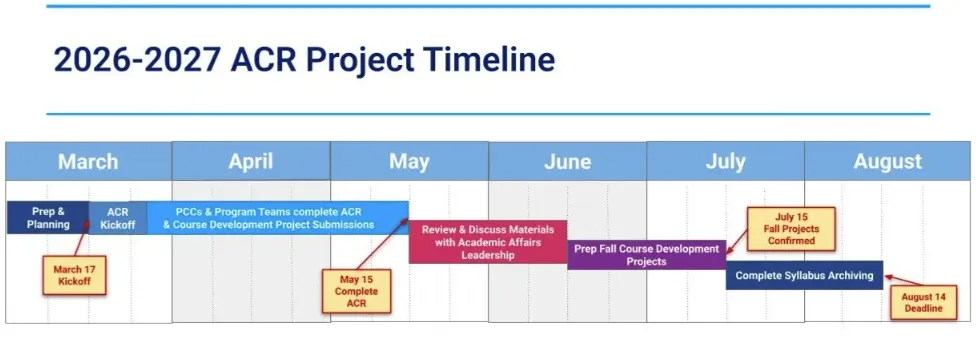
Deadline for completing 2026-2027 Annual Curriculum Review Deliverables: Friday, May 15, 2026
The ACR consists of three primary sections, with designated responsibilities and submission requirements. Please review the items below and send any questions to [email protected].
Resources:
- ACR Resources & Instructions - Updated each year with new templates & training materials for the upcoming academic year.
- ACR Deliverables Checklist
FULL INSTRUCTIONS FOR AY2026-2027 ANNUAL CURRICULUM REVIEW
- Complete all required documents in the Program Templates To Complete Folder:
- Program-specific AY26-27 ACR Program Template
- SWOT Analysis Update
- Curriculum Map Update
- Notify Academic Affairs via email to [email protected] once submissions are finalized.
- Academic Affairs Review & Discussions
- Leadership will review ACR submissions and course project plans.
- Meetings will be scheduled to discuss proposed changes.
- Decisions and feedback will be communicated via email.
Before completing the ACR, review the following data sources in your Inputs & Program Data folder:
[see: Grad Program ACR Drives for links to your program’s ACR drive & materials]
- Competitor Analysis documents
- Program Self-Study & Review Committee Report, if available
- Previous Year’s ACR & CIP Deliverables
- Syllabi of Record drive
- Additional program & curriculum data, including:
- PowerBI: Term & course enrollments
- Stakeholder Input: Faculty, industry, and student feedback
- Student Performance Data & Evaluations
For questions or assistance:
- Curriculum Mapping & Assessment: Phoebe Ballard ([email protected])
ACR Process, Submissions & General Inquiries: Academic Affairs - email [email protected]
DETAILED INSTRUCTIONS FOR SECTION I - PROGRAM OVERVIEW & PRIORITIES
Completed by: Program Director or designee
Location: Fill out SECTION I within the Program Planning & ACR Document for AY26-27 in the Templates to Complete Google folder
- Find program-specific links here: Program Drives & Templates
- Submit PCC member elections using this form: PCC Member Information Form
Provide a concise program description that includes:
- The official program name
- The program’s mission statement
- The existing Program Learning Outcomes (PLOs). Use the existing PLOs unless:
- They have been revised within the past year, or
- You are planning revisions in the upcoming academic year
- If PLO updates have been made (or are planned), briefly document what changes were made (or are proposed) and the rationale for the changes (e.g. curriculum revisions, shift in industry trends, student feedback).
This section should identify the 3–5 most critical priorities for the upcoming academic year. Priorities should reflect areas that require meaningful attention, improvement, or strategic investment. Avoid listing routine operational tasks. Focus on high-impact goals that will move the program forward.
Priorities must be:
- Specific – Clearly define what will be accomplished
- Measurable – Include concrete outcomes or benchmarks
- Time-bound – Include a defined timeline
- Action-oriented – Describe what will be done, by whom, and by when
Priorities also should align with:
- The program’s mission, vision, and learning objectives
- Budget planning discussions
- Enrollment target-setting meetings
- Other academic planning and strategic conversations
Programs should select 3–5 priorities across the following areas (you may focus on some areas more than others based on program needs):
- Curriculum (e.g., program redesign, course revisions, ARC reviews, modality additions)
- Partnerships (e.g., industry collaborations, cross-school initiatives, employer engagement)
- Student & Alumni Engagement (e.g., mentorship programs, networking initiatives)
- Admissions & Recruitment (e.g., targeted outreach strategies, pipeline development, conversion strategies)
- Faculty Development (e.g., hiring, training, mentorship structures)
- Assessment & Evaluation (e.g., accreditation reviews, learning assessment improvements, o).
Examples of Strong, Measurable Priorities
- Example 1 [Curriculum]: Conduct a comprehensive syllabus review to streamline content and maintain rigor. By Summer 2026, the PCC will audit 100% of program syllabi to identify redundancies and gaps and recommend revisions for implementation in AY26–27.
- Example 2 [Partnerships]: Develop strategic industry partnerships to enhance student opportunities. Establish at least two new collaborations with industry leaders by Spring 2027.
- Example 3 [Student & Alumni Engagement]: In collaboration with the Alumni & Development team, launch a Program Advisory Board with 8-12 alumni and industry professionals by Spring 2027. By Fall 2026, finalize board structure, recruit members, and schedule the first meeting.
- Example 4 [Admissions & Recruitment]: Increase Fall 2027 applications by 10% through targeted outreach. By Summer 2026, implement a strategy that includes faculty engagement, peer ambassadors, and personalized follow-ups.
- Example 5 [Faculty Development]: In collaboration with Faculty Assessment and Development, pilot an Adjunct Faculty Development Program by Fall 2026 to improve instructional effectiveness. Identify key development areas by Summer 2026, launch training sessions, and assess impact by Spring 2027.
- Example 6 [Assessment & Evaluation]: Implement an annual student outcomes survey to track graduate success and curriculum effectiveness. Achieve a 75% response rate within the first year and use findings to inform program improvements.
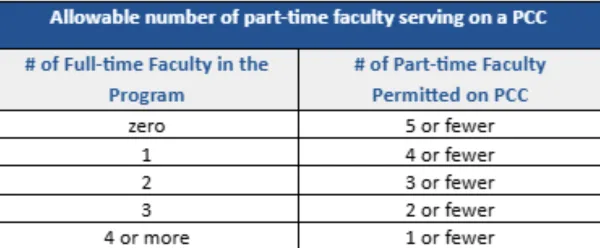
Submit the AY2026-2027 PCC Membership Form once for each of your proposed members that will serve on the Program Curriculum Committee during the upcoming academic year (Sept. 1, 2026 - August 31, 2027). Submit both new and returning members.
See: PCC Policy & Operating Guidelines and the chart below for composition guidance. Additional resources are available here.
PCC elections will be reviewed for policy and workload compliance.
DETAILED INSTRUCTIONS FOR SECTION II - CURRICULAR ASSESSMENT TOOLS
Completed by: Program Curriculum Committee
Location: Curriculum Map Sheet in Templates to Complete Google folder.
- Find program-specific links here: Program Drives & Templates
Resources
- SPS Curriculum Map Resources Folder
- Need assistance? Contact Phoebe Ballard, Assistant Dean of Academic Services and Innovation, at [email protected].
All programs must update their Curriculum Map Google Sheet to include both direct and indirect assessment measures. You can find your Curriculum Map Google Sheet in the Templates to Complete folder of your program-specific ACR Drive.
Completing the Program Curriculum Map for AY26-27:
- Confirm the Student Learning Outcomes (SLOs)
- Review the program’s Student Learning Outcomes (SLOs) to ensure they are current and aligned with the program’s mission and goals.
- If SLOs were revised during the past academic year:
- Ensure the updated outcomes are reflected consistently throughout the curriculum map.
- Confirm that all mapped courses and assessments still align with the revised outcomes
- Update Core and Elective Course Listings
- Review the core and elective course listings included in the map.
- Update the list to reflect any changes made in the past academic year:
- Remove discontinued courses
- Add newly approved courses
- Confirm course titles and numbers are accurate.
- Map Student Learning Outcomes to Courses
- Indicate where each SLO is addressed in the curriculum using the following designations:
- I (Introduction) – Students are introduced to the outcome.
- R (Reinforcement) – Students continue developing knowledge or skills related to the outcome.
- M (Mastery) – Students demonstrate advanced proficiency or mastery in the outcome.
- When completing the map:
- Ensure appropriate scaffolding across the curriculum, meaning students progress from Introduction → Reinforcement → Mastery.
- Confirm that each SLO is addressed in multiple courses and that mastery occurs in advanced or capstone experiences where appropriate.
- Indicate where each SLO is addressed in the curriculum using the following designations:
- Identify Direct Assessment Measures (Course-Level; Required)
- For each course, identify the specific assignments or evaluations used to assess student achievement of the SLOs.
- Examples of assessment methods include exams, projects, presentations, or other evaluation forms.
- Be specific.
- Instead of writing “individual assignment,” specify:
- “Case study presentation analyzing market entry strategies.”
- Specificity ensures clarity about:
- What competency is being assessed
- How it aligns with the SLO
- At what level (I, R, or M) it is being evaluated
- Instead of writing “individual assignment,” specify:
- Be specific.
- Identify Indirect Assessment Measures (Program-Level; Required)
- Identify indirect program-level measures that provide additional insight into student learning and overall program effectiveness.
- Examples include student course evaluations, exit surveys, alumni surveys, employer feedback, advisory board input, job placement data, and industry certification pass rates, etc.
- Indirect assessments help capture perceptions of learning, market relevance, and longer-term program impact.
Completed by: Program Curriculum Committee
Location: SWOT Document in Templates to Complete Google folder.
- Find program-specific links here: Program Drives & Templates
If your program has undergone meaningful changes, please update your Strengths, Weaknesses, Opportunities, and Threats (SWOT) Analysis document using Suggested Edits or Track Changes. If no major shifts have occurred, confirm that last year’s SWOT remains accurate. Once you complete your SWOT review, you will be asked to indicate on your ACR template:
- Whether your SWOT analysis remains accurate and current with no changes, OR
- If you have made revisions to the SWOT analysis using Suggested Edits or Track Changes.
Guiding Questions for Consideration During SWOT Analysis
- Strengths:
- What is particularly effective about the curriculum?
- What does your program do better than competitors?
- Which courses are most successful, and why?
- What elements (structure, pedagogy, industry integration, experiential learning) drive success?
- Can these elements be scaled or replicated?
- What distinctive assets (faculty expertise, partnerships, location, research strengths) strengthen your curriculum?
- Weaknesses:
- Where are there curricular gaps, redundancies, or inefficiencies?
- Are sequencing, prerequisites, or elective balance working effectively?
- Are students sufficiently prepared at program entry?
- Which courses are underperforming, and why?
- What resource constraints (faculty capacity, budget, expertise) limit curricular quality?
- Opportunities:
- Where does your curriculum lag behind competitors?
- What strengths of competing programs present areas to explore?
- What emerging market needs are not being addressed?
- What industry trends could be integrated into the curriculum?
- What unmet employer needs have been identified?
- How can the program leverage its existing strengths in new ways?
- Threats:
- What are competitors doing well that may challenge your positioning?
- What market or industry shifts could make parts of your curriculum less relevant?
- What enrollment, regulatory, or accreditation factors pose risk?
- Are there technological or pedagogical shifts that could disrupt your current model?
Completed by: Program Administrator
For redevelopments of existing courses, submit project details through your Program Course Development Report, linked here.
For New or Special Topic course developments, submit project details using the Course Development Report Submission Form.
Resources:
- Compensation Matrix by Project Type: Detailed course project type definitions & compensation rates.
2026-2027 Academic Year Course Proposals
This year, we have migrated course development project management from the previous Course Proposals Worksheet into a new Smartsheet system. Each program may view and update its planned course development projects through a dedicated program Course Development Report. The Course Development Report includes the active inventory and details of all courses for each graduate program. New and Special Topics course developments will be added to this report through a separate submission form. Program administrators responsible for course development projects will receive periodic project update requests and deadline reminders via email from Smartsheet to improve tracking. Follow the instructions below to access your Course Development Report and submit new and redeveloped course development projects.
Please use your Course Development Report to map out new course design or existing course redesign projects to execute during the upcoming 2026-2027 Academic Year. Each proposal should align with the priorities and curricular growth areas you have identified through the Annual Curriculum Review activities.
Submit details for course projects to kick off during the Fall 2026, Spring 2027, and Summer 2027 cycles. Required elements include:
- Faculty developer
- Modality of the course
- Comprehensive rationale for course project
- Timeline for course development and instruction
- Go to https://app.smartsheet.com/b/login
- Select Sign in with Google
- Sign in using your Columbia UNI and password.
- Complete DUO multi-factor authentication (MFA)
- If you cannot log in: Ensure you are using your UNI and Lionmail account, and try clearing your browser cache.
Accessing Your Smartsheet Course Development Report
As part of the Annual Curriculum Review process, programs should review the active program course inventory and update any inaccuracies. To review and update your course inventory:
- Access your Course Development Report in your program’s links section here.
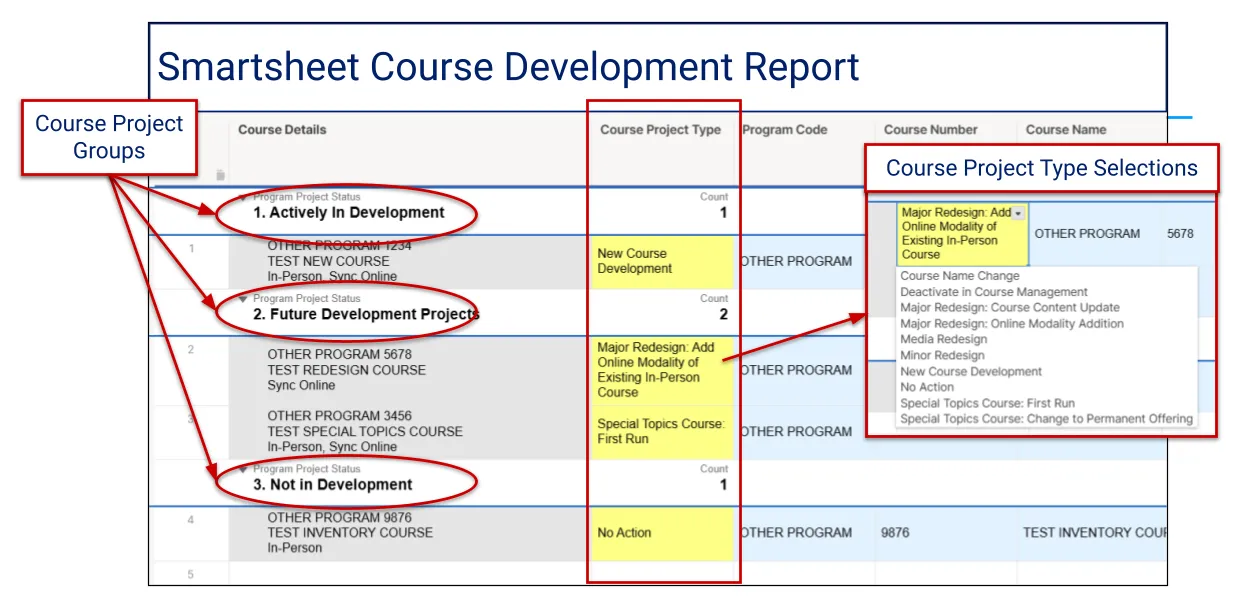
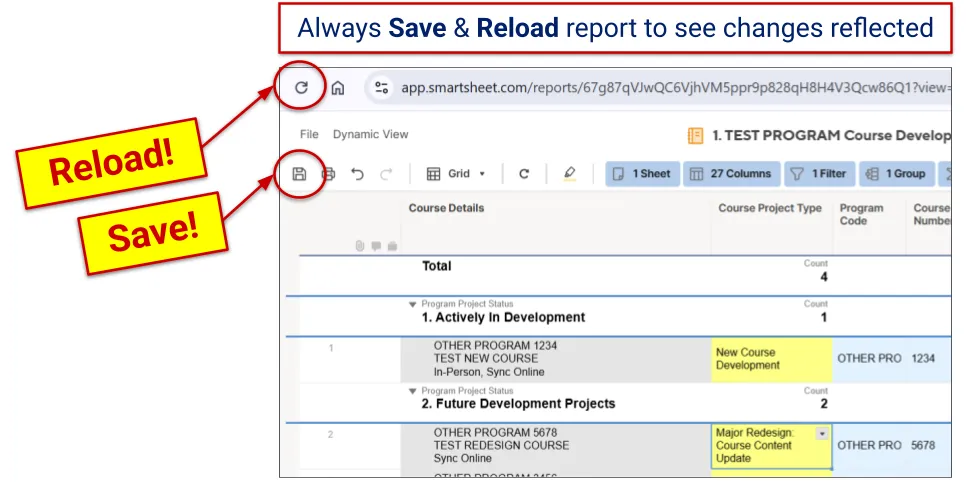
- All program courses will be divided into one of three “Program Project Status” sections. These include:
- Actively In Development - Course projects that are currently being developed by faculty, or those that are in the PCC or COI review phases. These courses have not yet completed development and approval for instruction. Course Project Types (in yellow-highlighted cell) may include New or Special Topics courses, Major, Minor, or Media Redesigns, or Course Name Changes.
- Future Development Projects - Course projects that are “in the pipeline” for development during an upcoming cycle that have not yet kicked off. Course Project Types may include New or Special Topics courses, Major, Minor, or Media Redesigns, or Course Name Changes.
- Not in Development - All other courses that are in the program’s curricular offerings, but are not slotted to undergo redevelopment. These courses should have a “No Action” Course Project Type.
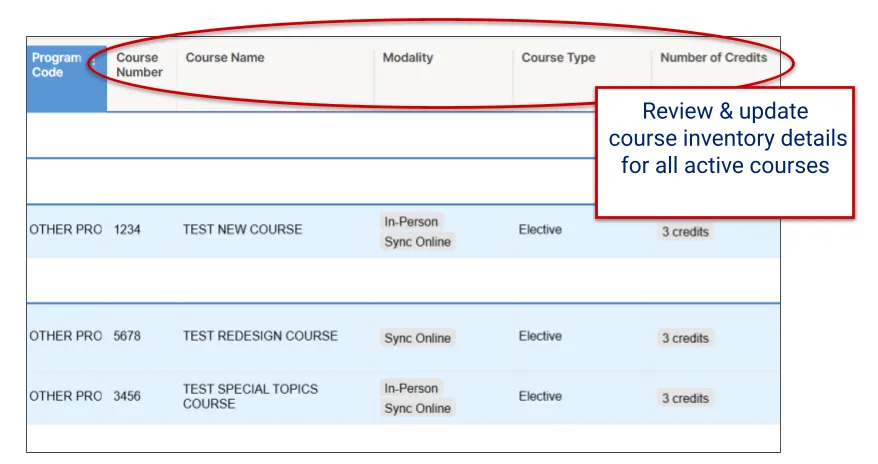
- Review all active course details
- scroll through the columns to the right, and update any incorrect information, such as revised titles, credit numbers, or course modalities.
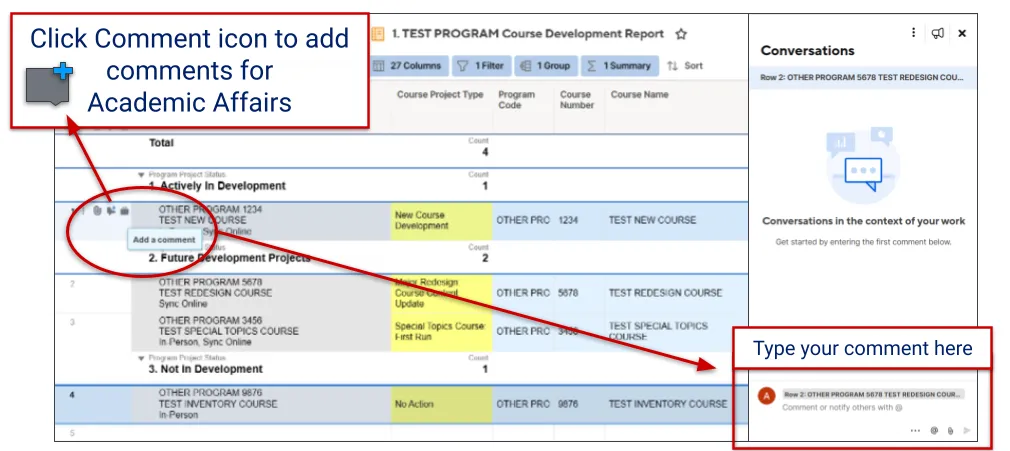
- Add comments for review by Academic Affairs by clicking the comment icon in the leftmost column of the course data row.
- Always SAVE then RELOAD the report page to reflect changes.
- See screenshots below.
- To Add Missing Courses To Your Report:
- Submit course details via the Smartsheet form
- Choose ‘Add Missing Course to Inventory’
- Fill out Program and Course Details for any missing courses. Include:
- Program Code, Course Name, Course Number, Number of Credits, Course Modality(ies), Core/Elective/Selective designation, and provide a brief description of the course.
- Logging Completed Projects:
- If any course development projects “Actively In Development” or in “Future Development Projects” have been completed or are no longer in the development project pipeline, change Course Project Type to ‘No Action’, update additional course details, and provide comments for context.
- Once details are complete, SAVE then RELOAD the report page.
- To add NEW or SPECIAL TOPICS course projects to your Course Development Report:
- Submit course details via this Smartsheet form once for each NEW or SPECIAL TOPICS course you plan to develop.
- Choose ‘New Course Development or Special Topics Course Submission’
- Fill out Program and Course Details for any missing courses. Include: Program Code, Course Name, Course Number, Number of Credits, Course Modality(ies), Core/Elective/Selective designation, course development and instruction timing, rationale, faculty developer details (if available) and any notes about the course or project.
- Submit form. New entries will be reflected in your Course Development Report under ‘Future Development Projects’.
- To add Course Redevelopment or other course project types to your Course Development Report:
- Visit your Smartsheet Course Development Report
- Select the Course Project Type that best suits the changes to the course you want to make from the drop-down menu.
- Fill out course project details, including course development and instruction timing, rationale, faculty developer details (if available), both general course project rationale and rationale details, the requested level of Instructional Design support (for online modalities), and any notes about the course or project.
- Once details are complete, SAVE then RELOAD the report page.
- Course development projects will be discussed during the Annual Curriculum Review meetings with Academic Affairs leadership.
Completed by: Program Administrator
Location: New “Annual Syllabus Archive” folder in your program’s Google drive
A new program requirement mandates that Program Administrators upload one current, base syllabus for every active course in their curriculum. This Course Syllabus Archiving is required to ensure curriculum alignment, document learning outcomes and rigor, meet accreditation and compliance needs, and support the annual Curriculum Improvement Plan (CIP) review. An "Active Course" is defined as any currently approved course eligible to be offered during the academic year, regardless of modality or whether it was scheduled for a particular semester.
Instructions for Program Syllabi Archiving
- Create a new “Annual Syllabus Archive” folder in your program’s Google drive.
- Add the link to this new drive folder to SECTION II, part D of your Program Planning & ACR Document
- Upload a PDF or Word syllabus document for each active course in your program’s curriculum. Note: A PDF of the most recent Canvas site is acceptable.
- File names should include program code, course number & abbreviated course name (ex: PRGM 5200: Intro to Analytics).
- Only one syllabus per course is required, you do not need to include syllabi for multiple sections of the same course.
- The deadline to upload all active syllabi is Friday, August 14, 2026.
DETAILED INSTRUCTIONS FOR SECTION III: CURRICULUM IMPROVEMENT PLAN (CIP) NARRATIVE
Completed by: Program Curriculum Committee
Location: Complete CIP within the Program Planning & ACR Document for AY26-27 in the Templates to Complete Google folder
- Find program-specific links here: Program Drives & Templates
The Curriculum Improvement Plan (CIP) Narrative is an annual strategic reflection on the quality, coherence, and future direction of your program’s curriculum. This is not a catalog of courses. It is an evidence-informed evaluation of how well the curriculum functions as an integrated learning experience and how effectively it prepares graduates for distinction in the field.
Your analysis should be grounded in learnings from your program’s Curriculum Map, SWOT analysis, and any relevant evidence (e.g., learning outcomes assessment results, course evaluations, student/alumni feedback, employer input, enrollment trends, placement data, industry developments). Focus on high-impact insights and strategic priorities rather than exhaustive detail. When possible, reference specific evidence to support your conclusions. See CIP Narrative prompts below.
1. Overall Curricular Coherence and Strength: Provide a holistic reflection on the curriculum as an integrated sequence.
Consider the following framing: How effectively does the curriculum function as a cohesive progression rather than a set of individual courses? Where does it most strongly support student learning and achievement of program-level outcomes? Which elements are central to the program’s identity and should be preserved or deepened?
2. Curricular Gaps and Areas for Growth: Identify the most consequential opportunities for improvement. Focus on high-impact issues rather than an exhaustive list.
Consider the following framing questions: What gaps, redundancies, or misalignments emerge from your curriculum map, assessment data, or stakeholder feedback? Where do students struggle to build skills progressively? Where may the curriculum lag behind current disciplinary or professional expectations?
3. Proposed Curricular Enhancements: Describe how you will strengthen the curriculum in response to identified priorities.
Consider the following framing questions:
If proposing new or revised courses: What gap or strategic need does each change address? How does it improve coherence, progression, or depth? How does it complement or replace existing courses without creating redundancy?
If no new courses are proposed: Why does the current structure remain appropriate? How can existing courses be revised or leveraged to address identified needs?
4. Field Direction and Strategic Priorities: Situate your curriculum within the broader trajectory of the field (3–5 year outlook).
Consider the following framing questions: What emerging competencies, technologies, methodologies, or regulatory/ethical considerations are shaping the discipline? Which developments are most critical for graduate success? How do your curricular priorities respond to these trends?